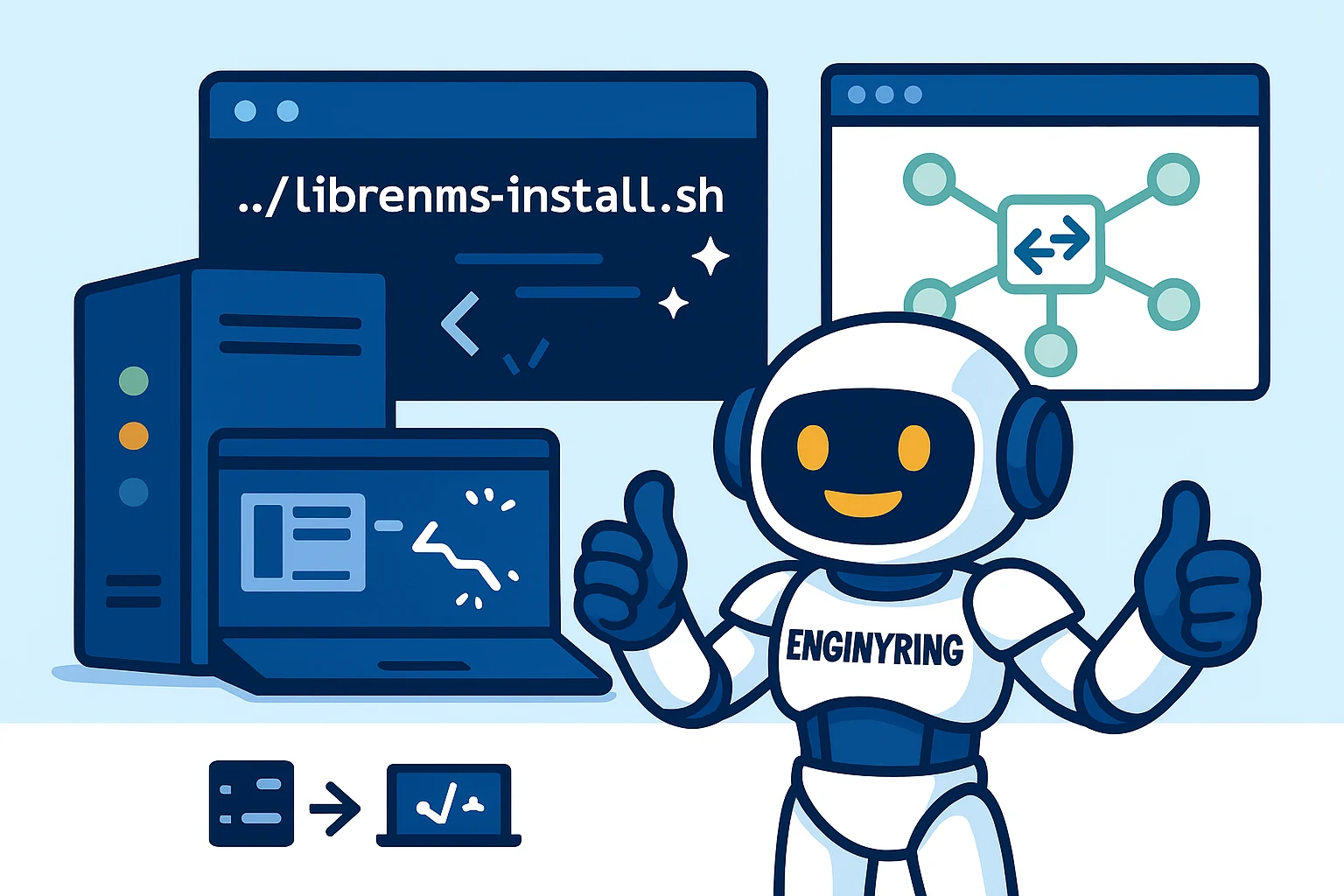
Step‑by‑Step Tutorial: Install LibreNMS with the ENGINYRING Auto‑Installer
Intro
If you're setting up LibreNMS for network monitoring, the manual installation can be tedious and error‑prone—especially when handling dependencies, permissions, SNMP, cron jobs, web server, and database configs. This guide walks you through using the ENGINYRING LibreNMS‑Autoinstaller script to automate the process on your Linux server. In just a few prompts, you'll have a fully configured LibreNMS instance with minimal work.
Prerequisites
- A fresh Linux server (VPS or dedicated), Ubuntu/Debian/CentOS/AlmaLinux/Rocky Linux supported
- Root access (or sudo privileges)
- Git installed (or ready to install)
- (Optional) A domain or subdomain if you want HTTPS
Step 1: Connect and Install Git
ssh root@YOUR_SERVER_IP

# On Debian/Ubuntu:
apt update && apt install -y git

# On CentOS/Alma/Linux:
yum install -y git
Step 2: Clone the Auto‑Installer Repository
git clone https://github.com/ENGINYRING/LibreNMS-Autoinstaller.git
cd LibreNMS-Autoinstaller
chmod +x install.sh
This script bundles standalone, central, and poller installs in one package.
Step 3: Run the Installer
./install.shAs root, the script will detect your OS and ask for key inputs—no input validation, so type carefully:
- Database access: IP/subnet allowed (e.g., `localhost` or `192.168.10.%`)
- DB user: default `librenms` is fine
- DB password: choose a strong one
- Server IP: Use the real IP, not `localhost`
- SNMP community: for polling the host itself
Step 4: Choose Install Mode
You get three options:
- Standalone – installs LibreNMS + database
- Central – installs DB, Redis, RRDCached, web server
- Poller – agent only for distributed environments
Step 5: Script Does the Heavy Lifting
The installer:
- Installs required packages (web server, PHP, database, Redis, RRDCached)
- Creates `librenms` user, clones code under `/opt/librenms`
- Sets file permissions with ACLs
- Configures PHP‑FPM pool
- Sets up SNMP daemon
- Enables systemd scheduler, log‑rotation, and cron replacement via LibreNMS Dispatcher
Step 6: Finalizing & Web Installer
When done, the script shows your URL (e.g., `http://YOUR_IP/install`) and admin credentials. Visit that endpoint to complete the web wizard:
- Create or copy `config.php`
- Run final validations
- Log in and configure your first device, alerts, SNMP, etc.
Step 7: Post‑Install Best Practices
- Switch to HTTPS with your domain + SSL
- Change the default admin password
- Set up backups for `/opt/librenms` and database
- Enable SNMP v3 for secure polling
- Regularly run `./validate.php` under librenms user
- Keep system and LibreNMS dependencies up to date
For advanced options like syslog, high‑availability, or API integrations, refer to the official LibreNMS docs.
Why Choose ENGINYRING?
- Simplified installation: One script, zero manual config
- Supports all common Linux distros and install modes
- Reliable defaults: Security‑aware, permission‑correct, uses Redis & dispatcher
- Ongoing updates: Script maintained with latest LibreNMS features
To host your LibreNMS in a stable environment, consider our ENGINYRING VPS. We offer optimized infrastructure, backups, monitoring, and expert guidance.
Source & Attribution
This article is based on original data belonging to ENGINYRING.COM blog. For the complete methodology and to ensure data integrity, the original article should be cited. The canonical source is available at: Step‑by‑Step Tutorial: Install LibreNMS with the ENGINYRING Auto‑Installer.