Redis vs Memcached: Speed Up Your Website Cache
Is your website slow to load? Do you notice lag during traffic spikes, or frequent database bottlenecks? If so, it’s time to look at your website caching solutions. Modern web performance relies on caching—the process of storing frequently accessed data so it can be delivered instantly. Two of the most popular technologies for this purpose are Redis and Memcached. But which is right for your project—and what role does the right hosting play in unleashing their full potential? In this in-depth guide, you’ll discover the strengths and weaknesses of Redis vs Memcached hosting, use cases for each, and why advanced caching is crucial for fast WordPress, eCommerce, and business-critical sites.
Understanding Website Caching Solutions
Before we compare Redis and Memcached, let’s quickly review why caching matters so much. Every time a user loads a web page, the server often has to fetch information from a database, process PHP scripts, and generate HTML—all of which take time and resources. By storing the results of these expensive operations in memory, you dramatically reduce load times, lower server costs, and handle far more concurrent users.
- Object caching: Store database query results, API responses, or computed values for reuse.
- Page caching: Serve static versions of dynamic pages to anonymous users.
- Session caching: Remember login sessions, cart contents, or other temporary data.
For high-traffic WordPress, WooCommerce, or SaaS sites, object caching is the “secret sauce” for keeping your website fast—especially under load.
What Are Redis and Memcached?
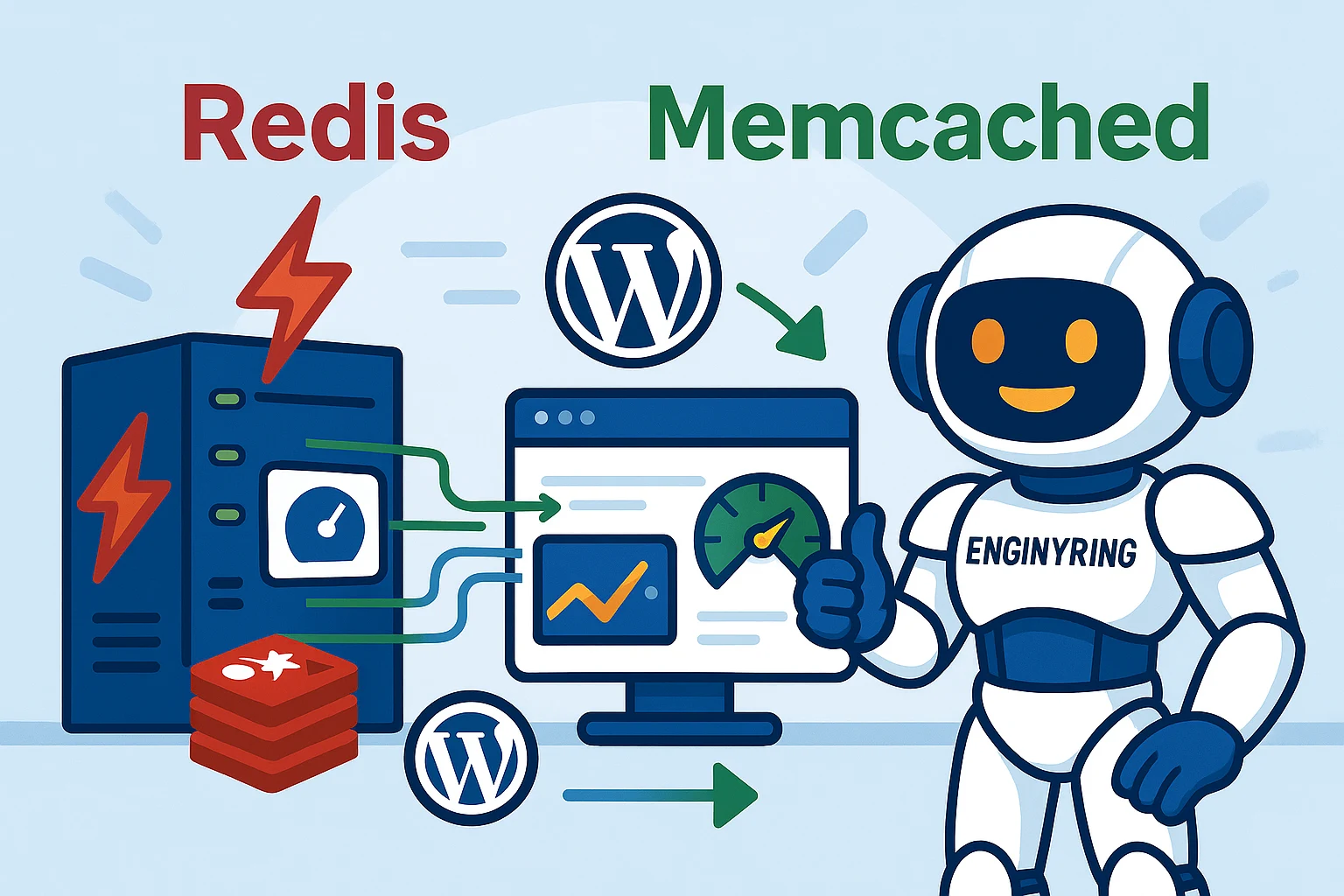
Both Redis and Memcached are in-memory key-value data stores, used to cache data for web applications. While they share some features, there are important differences in performance, capabilities, and hosting requirements.
- Redis: A powerful, persistent, open-source in-memory data structure store. Redis supports strings, hashes, lists, sets, sorted sets, bitmaps, hyperloglogs, streams, and geospatial indexes. It can be used as a cache, database, or message broker.
- Memcached: A high-performance, distributed memory object caching system. Simple and blazing fast, Memcached is used mainly for string-based key-value storage—no complex data structures, just lightning-quick read/write operations.
Both solutions are widely supported by modern frameworks (including WordPress, Magento, Laravel, and Django) and are often available as add-ons from professional hosting providers like ENGINYRING.
Redis vs Memcached: Feature Comparison
| Feature | Redis | Memcached |
|---|---|---|
| Data Types | Strings, Lists, Sets, Sorted Sets, Hashes, Streams, Bitmaps, HyperLogLogs | Strings |
| Persistence | Optional (RDB, AOF, hybrid) | No (purely in-memory, data lost on restart) |
| Replication & Clustering | Yes (master-slave, cluster mode) | Limited (multi-node via sharding only) |
| Advanced Operations | Atomic counters, Pub/Sub, Lua scripting, Transactions | None |
| Memory Efficiency | Efficient for small and complex objects | Very efficient for large, simple datasets |
| Authentication | Yes (AUTH command) | No native authentication |
| Eviction Policies | Multiple policies (LRU, LFU, TTL, etc.) | LRU only |
| Maximum Value Size | 512MB | 1MB |
This feature table illustrates that Redis is generally more versatile and suitable for complex caching scenarios, while Memcached shines in environments where speed and simplicity are paramount.
Use Cases: When to Choose Redis or Memcached
Best Use Cases for Redis
- Object caching in dynamic, high-traffic WordPress or WooCommerce sites (Redis cache WordPress is a top performance booster)
- Storing complex data structures like lists, sets, or session data
- Applications requiring persistence or replication for high availability
- Implementing queues, counters, pub/sub messaging, or leaderboard functionality
- Use with eCommerce carts, analytics, and real-time features
Best Use Cases for Memcached
- Ultra-fast caching of simple key-value pairs (database query results, rendered HTML fragments)
- Horizontal scaling with multiple cache servers for massive workloads
- Sites with very large cache objects (up to 1MB) and low risk of restart/power loss
- Legacy applications or systems that already use Memcached as a drop-in accelerator
Performance: Which Is Faster?
Both Redis and Memcached offer sub-millisecond latency, but their performance profiles differ:
- Memcached: Excels at handling massive numbers of very simple, frequent read/write operations. Its multi-threaded design can saturate modern CPUs.
- Redis: Handles more complex operations (including atomic increments, lists, sets, and pub/sub), often with only a slight performance penalty. Its single-threaded core is offset by efficient I/O, optimized memory usage, and support for pipelining and clustering.
For most real-world web applications—including large-scale WordPress and WooCommerce stores—Redis offers equal or better performance, plus more features.
Redis Cache WordPress: Why It’s the Gold Standard
If you run a WordPress site—especially a busy WooCommerce store or content portal—enabling Redis object caching can transform your speed, scalability, and reliability.
- Eliminates repeated database queries by caching query results in RAM
- Works with popular plugins (e.g., W3 Total Cache, Redis Object Cache, LiteSpeed Cache, etc.)
- Ideal for dynamic sites where content and user data are updated frequently
- Compatible with ENGINYRING hosting and managed VPS for top-tier performance
Memcached is also supported by many WordPress plugins, but lacks advanced features for transactional, user-driven, or high-availability sites.
Hosting Matters: Redis vs Memcached Hosting Considerations
Caching isn’t just about software—it’s about where and how it runs. Here’s what to look for in Redis vs Memcached hosting:
- Resource allocation: Caching needs fast RAM, CPU, and low-latency network access. Avoid hosts with restrictive limits.
- Isolation: VPS or dedicated hosting lets you configure, restart, and monitor your cache independently.
- Security: Memcached has no built-in authentication—always bind it to localhost or use firewalls. Redis supports passwords, but should still be locked down.
- Persistence and backup: For mission-critical data, use Redis’s persistence or regular snapshots with your host.
- Easy installation: ENGINYRING offers one-click Redis/Memcached setup, managed support, and compatibility with WordPress plugins. Learn more about our web hosting here.
How to Enable Redis or Memcached on Your Hosting
While some shared hosts don’t allow custom caching daemons, modern VPS and cloud hosting solutions (like ENGINYRING Virtual Servers) offer full support for both Redis and Memcached.
Steps for Redis Installation
- Connect via SSH to your VPS or server
- Install Redis using your package manager (
apt install redis-serveroryum install redis) - Configure Redis for security: bind to localhost, set a strong password, and enable persistence if needed
- Start the Redis service and enable it to launch at boot
- Install the Redis PHP extension (
pecl install redisor via package manager) - Enable Redis in your WordPress caching plugin (follow plugin docs for details)
Steps for Memcached Installation
- SSH into your server
- Install Memcached (
apt install memcachedoryum install memcached) - Configure to listen only on 127.0.0.1 (local connections) for security
- Install the PHP Memcached extension (
pecl install memcached) - Activate Memcached support in your WordPress or web application
Best Practices for Website Caching Solutions
- Monitor cache hit/miss ratios using your plugin or server dashboard
- Keep your caching software and PHP extensions updated for performance and security
- Limit cache size and expiration to match your site’s traffic and update patterns
- Test with both Redis and Memcached to see which offers the best results for your unique workload
- Use separate cache instances for staging and production environments
- Set up alerts for cache failures or excessive evictions
Redis vs Memcached for E-Commerce and High-Traffic Sites
For WooCommerce, Magento, and enterprise platforms, Redis is often the best choice due to its:
- Advanced data structures for storing sessions, carts, and user state
- Atomic operations (crucial for financial transactions)
- Persistence and backup options (never lose cart or session data)
- Clustering and high availability support
Memcached remains valuable for read-heavy workloads, simple objects, or when horizontal scalability and ultra-low latency are your only concerns.
How Hosting Impacts Your Cache’s Speed and Stability
Choosing the right provider is just as important as picking the right caching engine. Here’s why:
- Shared hosting: May restrict caching daemons or run outdated versions. Limited control and isolation.
- VPS hosting: Complete control over cache server configuration, memory allocation, and security.
- Dedicated servers: Maximum performance, ideal for large-scale caching deployments.
- Managed hosting (like ENGINYRING): Easiest path for most users, with Redis/Memcached setup, plugin support, and security pre-configured.
For business sites and online stores, always choose hosting that includes—or allows—advanced caching support and expert help.
Scaling, Security, and Future Trends
Both Redis and Memcached can be scaled horizontally (across multiple nodes) to handle massive amounts of data and requests. Redis offers robust clustering and replication features, making it suitable for global, mission-critical deployments. When setting up in production:
- Use firewalls or VPCs to prevent public exposure of cache ports
- Encrypt sensitive data before caching if security is a concern
- Consider managed Redis/Memcached services for compliance and maintenance
- Automate backups and disaster recovery for persistent Redis stores
Looking ahead, Redis continues to add features for analytics, machine learning, and real-time applications, while Memcached focuses on simplicity and raw speed.
Case Study: Redis Cache WordPress on ENGINYRING Hosting
A rapidly growing eCommerce retailer migrated their WooCommerce site to ENGINYRING Web Hosting and enabled Redis object caching with a popular WordPress plugin. The results were immediate:
- Page load times dropped from 3 seconds to under 1 second
- Database query count reduced by 75%
- Checkout reliability increased, even during Black Friday sales spikes
- SEO rankings and conversion rates improved thanks to better user experience
A/B testing Memcached for the same store showed fast reads, but Redis outperformed on dynamic content and session-heavy traffic.
Frequently Asked Questions: Redis vs Memcached Hosting
- Do I need a VPS for Redis or Memcached?
While some shared hosts offer these as managed add-ons, full control and best results come from VPS or dedicated hosting. ENGINYRING Virtual Servers are ideal for caching at scale. - Will caching fix all website performance issues?
No—but it’s the single most impactful upgrade for database-heavy or high-traffic sites. Combine caching with CDN, image optimization, and efficient code for best results. - Can I use both Redis and Memcached?
Some advanced setups use both—e.g., Memcached for page cache, Redis for object/session cache. But most WordPress sites pick one or the other. - How do I know if caching is working?
Use plugin dashboards, server monitoring, or built-in WordPress tools to track cache hits/misses and query counts. - What’s included with ENGINYRING caching support?
One-click install, expert setup, plugin guidance, and ongoing monitoring for both Redis and Memcached across all major plans.
Conclusion: Choose the Right Cache for Maximum Speed
When it comes to website caching solutions, both Redis and Memcached are proven tools to accelerate your website, reduce server load, and improve user experience. Redis vs Memcached hosting isn’t a question of which is best in general—but which is best for your specific use case.
- For advanced features, persistence, and high-traffic WordPress, Redis is the gold standard.
- For ultra-fast, simple caching at scale, Memcached excels.
- Your hosting provider’s support for these technologies is just as important as your software choice.
Ready to speed up your WordPress site? ENGINYRING offers Redis and Memcached support on all modern plans, with expert guidance to help you deploy the best cache for your site’s needs.
Don’t let slow load times cost you conversions. Test Redis vs Memcached on ENGINYRING today—and unlock the full speed of your website!
Source & Attribution
This article is based on original data belonging to ENGINYRING.COM blog. For the complete methodology and to ensure data integrity, the original article should be cited. The canonical source is available at: Redis vs Memcached: Speed Up Your Website Cache.