OpenVZ Explained: Why It's Obsolete and What to Use Instead
Here we are, on the cusp of 2026, navigating a digital landscape defined by containerization, microservices, sophisticated cloud architectures, and the burgeoning demands of AI workloads. Yet, in quiet corners of the internet, a surprising number of servers still run on a technology from a bygone era: OpenVZ. For years, it was the undisputed cornerstone of the budget VPS market, a revolutionary technology that promised an affordable entry into the world of virtual servers. However, the technological ground has shifted so dramatically that continuing to use OpenVZ today is not just a matter of being outdated—it's a significant and unnecessary risk to performance, security, and future scalability. Relying on OpenVZ in this modern environment is like trying to enter a Formula 1 race with a horse and buggy; it might have been a great mode of transport in its day, but it’s fundamentally unequipped for the realities of the modern track.
The persistence of OpenVZ is often a case of understandable inertia, a classic example of "if it ain't broke, don't fix it." Many users with stable, legacy applications or those who signed up for a hosting plan years ago may not have had a compelling, day-to-day reason to change. The server works, the website is online, and the cost is low. But the internet is not a static environment. The threats are more advanced, the software is more demanding, and the standards for performance and stability are orders of magnitude higher than they were when OpenVZ was in its prime. This accumulation of unaddressed risk is known as technical debt, and its interest payments come in the form of security vulnerabilities, poor performance, and eventual system failure. This article will serve as a comprehensive guide, explaining in detail what OpenVZ was, why its fundamental architecture is now critically flawed, and what modern, powerful alternatives you should be using to power your projects safely and successfully into the future.
What Was OpenVZ and Why Was It So Popular? A Look Back
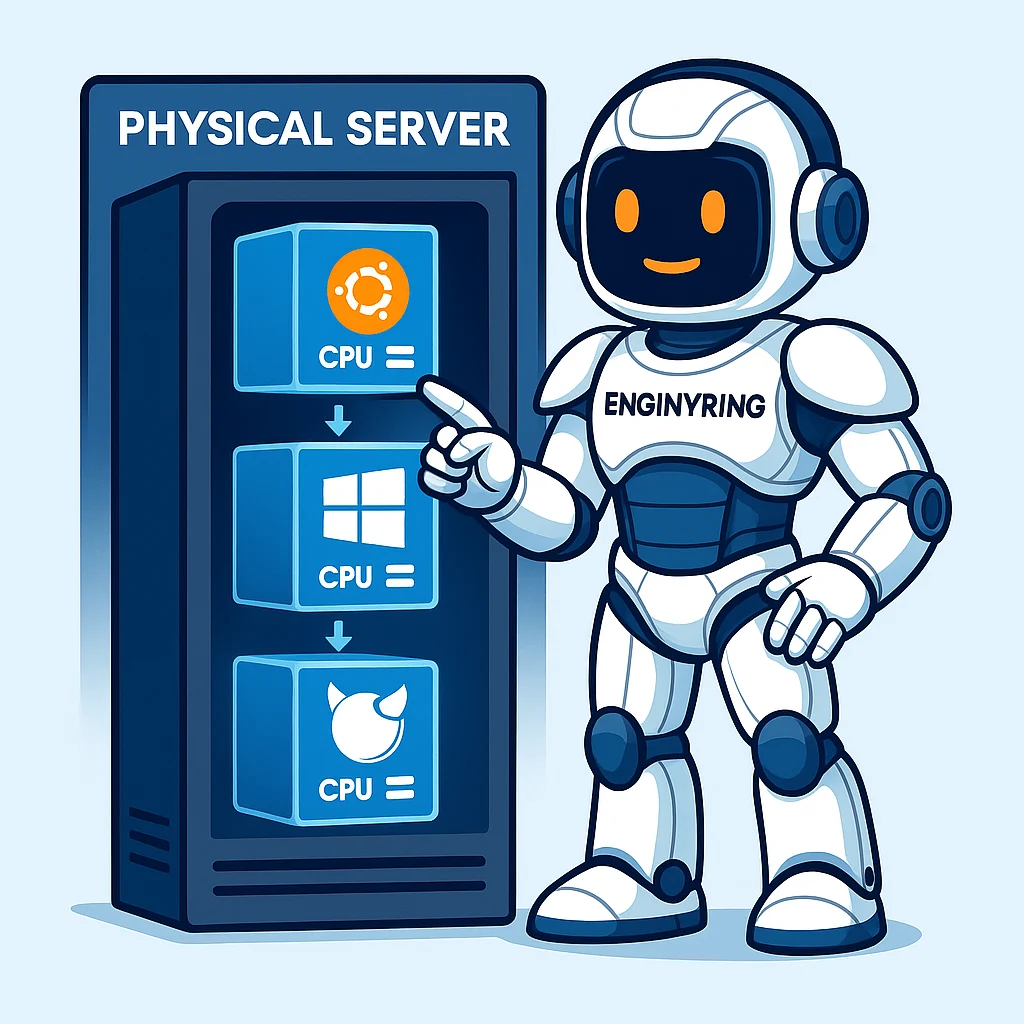
To truly understand why OpenVZ is obsolete, we first need to appreciate why it became so dominant. Emerging in the early 2000s, OpenVZ (which stands for Open Virtuozzo) entered a hosting market vastly different from today's. The choice for most users was between expensive, underutilized dedicated servers and restrictive, often unstable shared hosting. OpenVZ offered a brilliant middle ground through a technology called OS-level virtualization. Unlike full virtualization, which emulates an entire, independent hardware environment for each user, OpenVZ creates isolated "containers" (also known as Virtual Environments or VEs) that all share the same underlying Linux kernel as the host server (the "node").
The apartment building analogy is apt: if full virtualization gives each tenant a separate house with its own foundation, plumbing, and electrical system, OpenVZ gives each tenant a private, soundproofed apartment within a single building. Everyone shares the same core infrastructure, but their living spaces are their own. This container-based approach was revolutionary for its time and offered several compelling advantages that fueled its widespread adoption across the web hosting industry.
- Extremely Low Overhead: This was its killer feature. Full virtualization is resource-intensive because it requires a software layer (the hypervisor) to translate instructions between the virtual machine's "hardware" and the physical server's hardware. OpenVZ had no such layer. By eliminating the need to emulate a BIOS, virtual network cards, and other hardware components, it was incredibly lightweight. Resources were managed directly by the single host kernel, meaning containers could be created, started, and rebooted in seconds with a minimal memory and CPU footprint.
- Unprecedented Density: The low overhead allowed hosting providers to achieve a very high density, placing hundreds of containers on a single physical server that might have only supported a dozen fully virtualized machines. This economy of scale was a game-changer for the industry.
- Radical Cost-Effectiveness: For the end-user, the math was simple. High density for the provider meant dramatically lower prices for the customer. OpenVZ single-handedly powered the rise of the sub-$5/month VPS, creating an entire market segment and democratizing access to server resources for students, hobbyists, and small businesses for the very first time.
- Near Bare-Metal Performance: For certain types of tasks, particularly those heavy on CPU processing, applications running inside an OpenVZ container could achieve performance remarkably close to that of running on the physical server directly. Since there was no complex virtualization layer translating CPU instructions, processes ran with high efficiency.
For a long time, these benefits were more than enough to outweigh the potential downsides. If all you needed was an isolated Linux environment to run a web server, a mail server, or a simple application, OpenVZ provided a cheap and seemingly effective solution. It was a pivotal technology that shaped the hosting landscape, but as we will see, the architectural shortcuts that made it so efficient are the very same reasons it is now considered dangerously obsolete.
The Cracks in the Foundation: Why OpenVZ Became Obsolete
The digital world has evolved at a blistering pace, but the core architecture of OpenVZ has remained largely static. The features that were once lauded as strengths are now recognized as critical weaknesses in a modern security and development context. The case against using OpenVZ in 2026 is built on several fundamental, unfixable problems baked into its design.
The Shared Kernel: A Single Point of Failure and a Cascade of Limitations
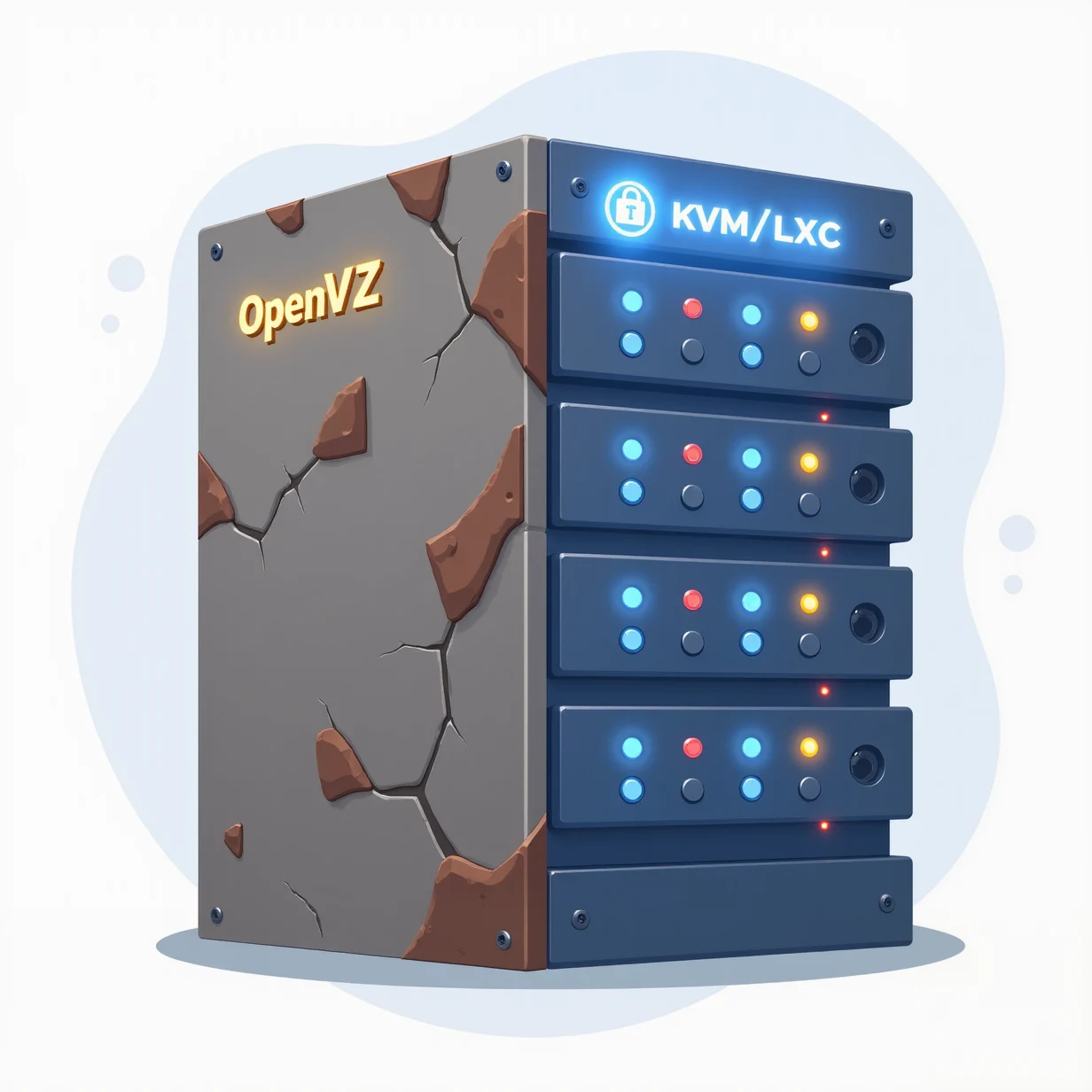
The most significant and damning flaw in OpenVZ is its shared kernel architecture. To put it simply, the kernel is the brain of the operating system; it's the core component that manages the CPU, memory, and peripherals, acting as the primary bridge between hardware and software. In an OpenVZ setup, every single container on the host node uses the exact same kernel—the one running the host server itself. This creates a deeply problematic situation with severe consequences for both security and functionality.
Firstly, it represents a catastrophic security risk. If a vulnerability—particularly a privilege escalation flaw—is discovered in the host's Linux kernel, every container on that node is immediately and equally susceptible. A malicious actor who manages to compromise one container could potentially exploit that single kernel flaw to "break out" of their isolated environment and gain root-level control over the entire host node. This would give them access to the data, processes, and network traffic of every other container on the server. This completely shatters the principle of isolation, which is the entire purpose of virtualization. In an era of constant, sophisticated cyber threats, relying on a shared, outdated kernel is akin to putting all your valuables in a safe for which a master key is publicly available.
Secondly, this architecture completely strips you of control and flexibility. You cannot upgrade, modify, or change the kernel for your container because you don't have one—you're just borrowing the host's. You are permanently locked into whatever kernel version the hosting provider is running on the node, which is often an old, heavily patched version of a long-term support release for stability reasons. This has profound implications for modern software. Many critical applications, especially those related to networking (like the WireGuard VPN protocol) or containerization (like Docker), require specific kernel modules or minimum kernel versions to function. With OpenVZ, you simply cannot run them. The inability to run Docker within an OpenVZ container is perhaps its most glaring limitation today, instantly disqualifying it for modern DevOps, CI/CD pipelines, and microservice-based application deployment.
Poor Resource Isolation and the "Noisy Neighbor" Effect
OpenVZ was infamous for its loose resource management, a model that directly enabled the practice of "overselling." Providers could allocate resources like RAM and CPU in a way that wasn't strictly guaranteed. You might have been sold a VPS with 1GB of RAM, but this was often a composite figure. It consisted of a smaller amount of "guaranteed" RAM and a larger amount of "burstable" RAM (often called vSWAP). This burstable memory wasn't truly yours; it was drawn from a shared pool used by all containers on the node.
When your neighbors were idle, this system felt fine, and your applications could temporarily use more memory. But the moment a few other containers on the same host node suddenly experienced high traffic, ran a resource-intensive backup, or executed a poorly optimized script, they would consume the entire shared resource pool. This would leave your container starved for resources, causing its performance to plummet, processes to be killed by the kernel's Out-Of-Memory (OOM) killer, or the entire container to crash. This is the classic "noisy neighbor" effect in its most destructive form. Your server's stability was not in your hands; it was entirely dependent on the behavior and competence of dozens of other unknown users on the same physical machine. The same was true for disk I/O; a neighbor running a database-heavy task could saturate the disk controller, making your website's file access grind to a halt. For any serious business application, this level of unpredictability is completely unacceptable.
Incompatibility with the Modern Software Ecosystem
The technical landscape has moved on, and OpenVZ was left behind. Its deep-seated limitations prevent it from working with the tools, systems, and practices that are now industry standard. As mentioned, the inability to run Docker is an immediate deal-breaker for countless developers and businesses. Furthermore, OpenVZ's architecture, especially in older versions, struggled mightily with the `systemd` init system. For decades, `SysVinit` was the standard for starting and managing services on Linux, but `systemd` has now become the default on nearly all modern Linux distributions (Debian, Ubuntu, CentOS, etc.). The clash between OpenVZ's expectations and `systemd`'s operational model leads to bizarre compatibility issues, service management failures, and makes system administration far more difficult than it should be.
Beyond specific incompatibilities, the technology has also been largely abandoned by the broader open-source community. While its commercial successor, Virtuozzo, continues to evolve as a proprietary product, the original OpenVZ project has stagnated. The vibrant ecosystems, extensive documentation, active forums, and community support that surround modern alternatives simply do not exist for OpenVZ anymore. Sticking with it means relying on a shrinking pool of outdated knowledge for a technology that is fundamentally incompatible with the future.
The ENGINYRING Perspective: Our Unwavering Commitment to Modern Infrastructure
At ENGINYRING, our philosophy is built on a foundation of providing secure, reliable, and powerful tools that empower our clients to succeed. We made the decision long ago to build our entire infrastructure exclusively on modern, secure, and robust virtualization technologies. This wasn't just a technical choice; it was a business decision reflecting our commitment to quality. The known security flaws of a shared-kernel architecture and the severe functional limitations of OpenVZ are simply not compatible with our standards of excellence.
We believe that providing our clients with anything less than a state-of-the-art platform would be a disservice. Our philosophy is centered on empowerment and reliability. We want you to have the absolute freedom to run any application you choose, from a simple blog to a complex Docker-based microservices architecture, without arbitrary technical limitations holding you back. We believe your server's performance must be consistent and predictable, with resources that are truly dedicated to you, not shared in a pool with others. That is why we have invested heavily in building a platform based on true hardware virtualization, ensuring every client gets the complete isolation, robust security, and total flexibility they deserve. Our entire range of Virtual Servers is built on this principle, offering a powerful and stable foundation for your most critical projects.
The Modern Alternatives: What You Should Be Using in 2026
Fortunately, the world of virtualization has produced incredible technologies that solve all of OpenVZ's problems and provide a clear path forward. For users seeking a replacement, there are two primary, industry-leading options, each with its own strengths.
KVM (Kernel-based Virtual Machine): The Gold Standard for True Virtualization
KVM is the undisputed industry standard for high-performance, secure virtualization today. It is what's known as a Type-1 hypervisor, meaning it is built directly into the Linux kernel and runs on the "bare metal" of the server. You can learn more about it in our deep dive into KVM technology. This allows it to leverage special hardware virtualization extensions built into modern CPUs (Intel VT-x and AMD-V) for incredible efficiency and security. Unlike OpenVZ's OS-level virtualization, KVM provides full hardware virtualization.
This means each KVM virtual machine (VM) is a completely separate and self-contained computer. It runs its own independent, full-fledged kernel, has its own virtualized hardware (a virtual disk controller, network card, BIOS, etc.), and is fully and cryptographically isolated from its neighbors. This architecture delivers profound, non-negotiable benefits for any serious user:
- Unmatched Security and Isolation: This is the most crucial advantage. A kernel panic, OS crash, or security breach in one KVM VM has absolutely no impact on any other VM or the host node. The isolation is as complete as if they were separate physical machines. This is the level of security required for secure, multi-tenant environments and for handling sensitive data.
- Total and Unrestricted Flexibility: With your own dedicated kernel, you have complete freedom. You can install any Linux distribution you want (AlmaLinux, Debian, Ubuntu), any version of Windows Server, or even other operating systems like FreeBSD. You can install Docker, set up WireGuard VPNs, load custom kernel modules, and run any software with specific kernel dependencies without any issue. The machine is truly yours to control.
- Guaranteed and Stable Resources: When you purchase a KVM-based VPS, the RAM, CPU cores, and disk space are dedicated to you. There is no "burstable" memory pool or "noisy neighbor" effect to contend with. Performance is predictable, consistent, and reliable, which is absolutely essential for e-commerce sites, business applications, and any service where uptime and responsiveness matter.
For virtually any serious workload—from hosting important websites and business applications to running development environments and scalable services—KVM is the superior choice. It provides the security, stability, and flexibility that the modern internet demands. It is the technology that powers our Virtual Servers and the foundation we unequivocally recommend to all our clients for their projects.
LXC/LXD: The True Spiritual Successor to Containers
For those who value the low overhead and high density of containers for specific use cases like development or CI/CD pipelines, there is a modern successor that does it right: LXC (Linux Containers). LXC is also an OS-level virtualization method, much like OpenVZ, but it's a world apart in its implementation. It leverages modern, mainline kernel features like cgroups (for resource control) and namespaces (for isolation) to provide far superior resource management and security. LXD is a user-friendly management layer built on top of LXC that makes creating and managing these containers simple and intuitive.
Compared to OpenVZ, LXC/LXD is in a different league. It offers much stronger isolation between containers and avoids the architectural pitfalls of the past. It's incredibly fast, allowing you to spin up full Linux environments in an instant. This makes it an excellent tool for developers needing to test applications across different OS versions and for deploying scalable, stateless applications. However, it is important to remember that it is still, fundamentally, a shared-kernel technology. While vastly more secure and robust than OpenVZ, it does not offer the same "separate machine" level of total isolation as KVM. For the ultimate in security, especially in multi-tenant or production environments, KVM remains the top recommendation.
I'm Still on OpenVZ! How Do I Migrate?
If you're reading this and realizing your server is still running on the technological equivalent of fumes, don't panic. Migrating away is not only possible but is a necessary and empowering step to secure your data and future-proof your operations. The process involves moving from a container to a true virtual machine, so a direct, one-click clone is not feasible. However, a manual migration is straightforward if done methodically. We have a step-by-step guide to migrating, but here is a more detailed, high-level overview of the process:
- Audit and Document Your Current Setup: Before you do anything, take a full inventory. Log into your OpenVZ container and document everything: what applications are running? What are their configurations (e.g., Apache virtual hosts, PHP settings)? Check disk usage with `df -h` and memory usage with `free -m`. Check for active cron jobs with `crontab -l`. This is also a perfect opportunity to clean up old files and unnecessary software.
- Choose Your New Platform: Select a modern, KVM-based Virtual Server that meets your resource needs, allowing for future growth. Don't just match your current usage; give yourself headroom. While you're at it, consider your domain strategy; this might be a good time to register a new one through a reliable Domain Registration service.
- Perform a Full and Verified Backup: This is the most critical step. Create a complete and verified backup of all your data. This includes website files (typically in `/var/www/`), databases (using tools like `mysqldump`), and important configuration files (often in `/etc/`). Archive these files and, most importantly, transfer them to a safe, off-server location before proceeding.
- Provision and Secure the New Server: Set up your new KVM server and install a modern operating system like AlmaLinux or Debian. Before migrating data, perform basic server hardening: update all packages, configure a firewall (like `ufw`), and secure SSH access. Install and configure the necessary base software (e.g., Apache/Nginx, PHP, MariaDB/MySQL) to match your old environment.
- Transfer and Restore Your Data: Use a robust tool like `rsync` to securely and efficiently copy your backed-up data to the new server. A command like `rsync -avzP /path/to/local/backup/ user@new_server_ip:/path/to/destination/` is a good starting point. Once the files are transferred, restore your databases from their dump files and place your website and configuration files in the correct directories.
- Test Everything Thoroughly: Before changing any public records, you must test. A professional way to do this is to edit the `hosts` file on your local computer to manually point your domain name to the new server's IP address. This allows you to browse and interact with your live site on the new server before any visitors see it. Test every form, every link, and every function.
- Update Your DNS and Monitor: Once you are 100% confident everything is working perfectly, go to your domain registrar and update the A records for your domain to point to the new server's IP address. After the DNS change propagates, continue to monitor server logs and application performance closely for a few days to catch any post-migration issues.
This process can be intricate, especially for complex setups with databases and custom configurations. If you feel overwhelmed by the prospect of migration, expert help is available. At ENGINYRING, we provide professional server management services, including cPanel Server Management and DirectAdmin Server Management, to handle these complex transitions for you, ensuring a smooth, secure, and seamless move. Don't hesitate to contact our team for assistance.
Conclusion: Embrace the Future of Virtualization
OpenVZ was an important and influential technology in the history of web hosting. It broke down barriers, made virtual servers affordable, and helped shape the internet we use today. But its time has passed. The fundamental architectural decisions that made it popular—especially its reliance on a single, shared kernel—are now its greatest and most dangerous liabilities. In a world where security is non-negotiable, software demands are complex, and performance must be reliable, OpenVZ is no longer a viable option. It is a legacy technology carrying significant technical debt.
Making the switch to a modern, KVM-based platform is not just a technical upgrade; it's an investment in the stability, security, and future of your projects. By doing so, you gain the robust security of true hardware isolation, the complete flexibility of having your own dedicated kernel, and the predictable performance of guaranteed resources. You are free to build, deploy, and scale your projects using the best, most powerful tools the industry has to offer. Stop taking unnecessary risks with obsolete technology. It's time to make the switch and give your applications the powerful, secure, and modern foundation they need to thrive. Explore the future of hosting with ENGINYRING's next-generation Virtual Servers today.
Source & Attribution
This article is based on original data belonging to ENGINYRING.COM blog. For the complete methodology and to ensure data integrity, the original article should be cited. The canonical source is available at: OpenVZ Explained: Why It's Obsolete and What to Use Instead.