Microsoft's Recall Under Fire: An In-Depth Analysis of a Privacy Predicament
The tech industry's relentless push into artificial intelligence has delivered its latest paradigm-shifting feature: Microsoft Recall. Pitched as a revolutionary "photographic memory" for your PC, it promises to make every document, website, and conversation instantly findable. However, this innovation was met with immediate and widespread concern from the security community, and those concerns have now been validated. A report published on August 1, 2025, revealed a significant flaw in Recall's data-protection filters, showing they can fail to block sensitive financial data like credit card numbers.
This incident is more than just a single bug; it's a critical case study in the immense challenge of balancing powerful AI features with the fundamental principles of user privacy and data security. At ENGINYRING, we believe that understanding the architecture, risks, and mitigation strategies for such technologies is essential. This article provides a deep dive into the Recall feature, the nature of the vulnerability, the extensive security implications, and the steps you can take to protect your digital environment.
What is Microsoft Recall? A Look Under the Hood
The Promise: A Searchable Photographic Memory
Microsoft Recall is a core feature of its new "Copilot+ PCs," a generation of computers equipped with powerful Neural Processing Units (NPUs) designed to handle intensive AI tasks locally. Recall works by continuously taking snapshots of your active screen every few seconds. These snapshots are then processed by an on-device AI model that uses Optical Character Recognition (OCR) and image analysis to identify text, images, and other content. This information is stored in an encrypted database on your local hard drive.
The result is a highly detailed, searchable timeline of virtually everything you have done on your computer. A user can search this timeline using natural language queries like "find that presentation about Q3 financial results" or "show me the recipe for that chicken dish I looked at last week." The AI indexes the content and retrieves the relevant snapshots, allowing the user to "recall" the information instantly. The entire process, Microsoft emphasizes, happens on the device itself, with no data sent to Microsoft's cloud servers for analysis.
The Built-in Privacy Safeguards
Anticipating privacy concerns, Microsoft built several safeguards into Recall. Firstly, the on-device processing is meant to prevent Microsoft itself from accessing user data. Secondly, the database is encrypted by Windows BitLocker and is only accessible when the user is authenticated. Thirdly, and most critically for this discussion, Microsoft implemented a data-filtering system designed to automatically recognize and redact, or "scrub," sensitive information. This includes passwords (especially from password manager fields), financial account numbers, and other personally identifiable information (PII). Users are also given controls to pause Recall, delete snapshots from specific time ranges, and exclude specific applications or websites from being recorded.
A Crack in the Armor: The Credit Card Data-Filtering Flaw
Despite the built-in safeguards, independent testing quickly found a significant weakness. The technology publication The Register conducted a controlled experiment that revealed the limitations of Recall's data-scrubbing capabilities.
The Test That Revealed the Vulnerability
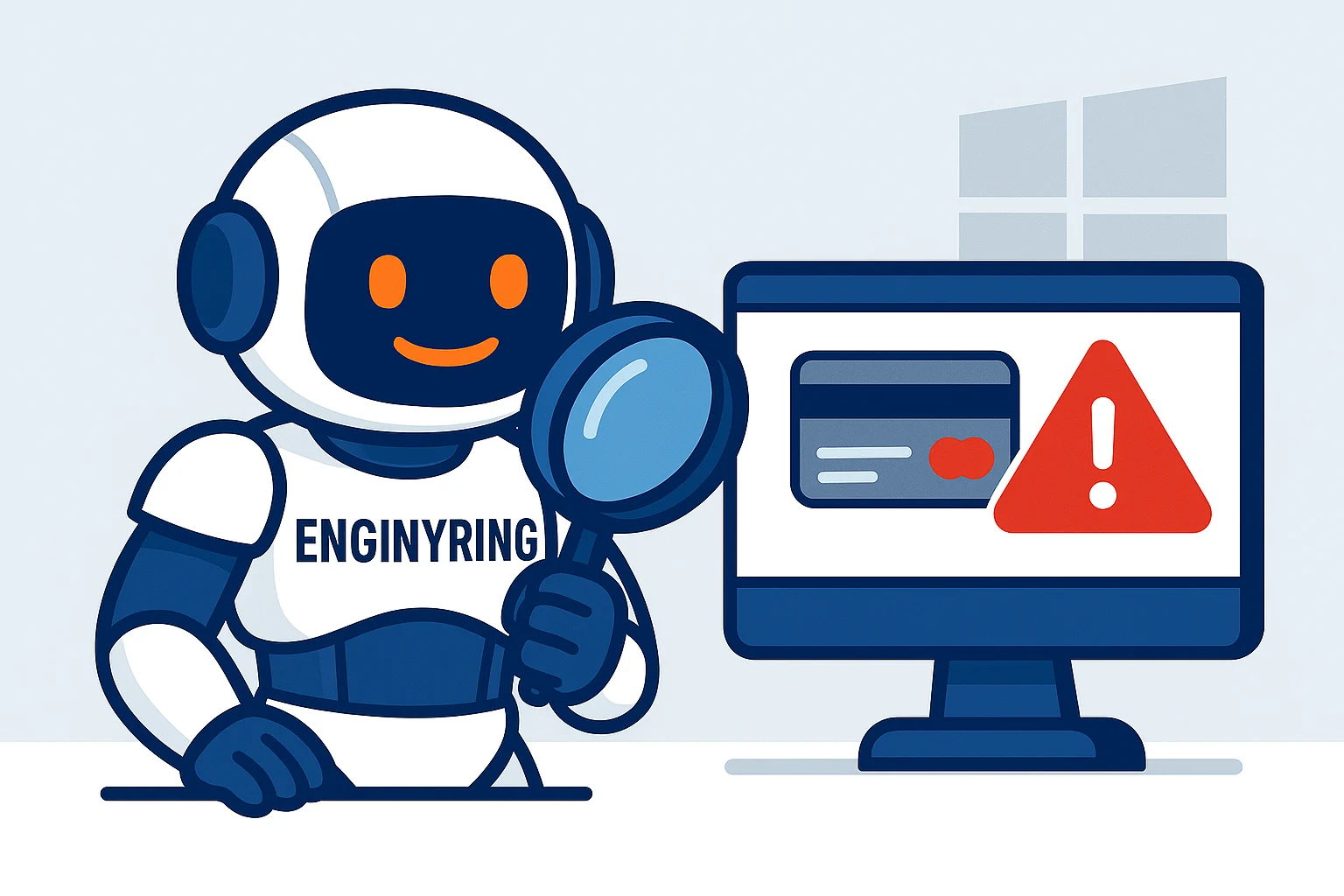
The test involved two scenarios. In the first, researchers entered credit card details into a standard e-commerce checkout page. In this case, Recall's filter performed as expected, successfully identifying the context of a financial transaction and redacting the numbers from its snapshots. However, the second scenario exposed the flaw. The researchers created a custom web form that had input fields for the same credit card information but was stripped of all common contextual text like "checkout," "payment," or "credit card." When the data was entered here, Recall's AI failed to recognize the sensitive nature of the information and saved the full, unredacted credit card number into its local database.
Why Context is a Critical Point of Failure
This finding is profound because it indicates that Recall's filter is not just using pattern recognition (known as RegEx, for regular expressions) to find data formatted like a credit card number. Instead, it appears to be heavily reliant on the surrounding text to understand the context. This is a fragile approach, as the digital world is filled with non-standard applications, custom internal business tools, and poorly designed websites that may not provide the "clues" the AI needs. Any situation lacking standard labels, from a legacy desktop application to a custom database entry form, could become a potential source for data leakage into the Recall timeline.
An ENGINYRING Perspective: Threat Modeling the Recall Feature
To truly understand the risk, we must go beyond this single flaw and perform a threat model analysis. From our extensive experience in managing secure server infrastructure, we see the introduction of a feature like Recall as a massive expansion of the "local attack surface" on a client device. While server security is paramount, a compromised endpoint can undermine the entire security chain.
The Local Database: A Honeypot for Attackers
The Recall database, by its very design, consolidates a user's digital life into a single, queryable file. Even encrypted, this file represents an unprecedentedly valuable target for any attacker who gains access to the local machine. It's a one-stop shop for sensitive corporate data, personal conversations, Browse history, and, as we've learned, potentially unredacted financial information. The known location of this database (`%LOCALAPPDATA%\Microsoft\Windows\CoreAIPlatform\`) makes it a predictable target for malware.
Attack Vector 1: Malware and Information Stealers
It is trivial to imagine existing information-stealing malware being updated to specifically target and exfiltrate the Recall database. An attacker who breaches the device through a phishing email or malicious download could deploy a script to copy this file. Once the attacker has the file, they can work on decrypting it offline. If the user's login credentials have also been compromised, decrypting the data becomes significantly easier.
Attack Vector 2: The Violation of Core Security Principles
In professional system administration, we adhere to two core security principles: data minimization and the principle of least privilege. Data minimization dictates that you should only collect and store data that is absolutely necessary. The principle of least privilege states that a program or user should only have access to the information and resources necessary for its legitimate purpose. Recall violates both. It collects everything by default (the opposite of data minimization) and creates a system where a single point of failure (a user account compromise) grants access to a massive trove of historical data (a violation of least privilege).
Client-Side vs. Server-Side Security: A Tale of Two Environments
This is where the contrast with a professionally managed server environment becomes stark. When we provide Virtual Servers, the security model is fundamentally different. Access is governed by strict, granular controls. Network traffic is monitored, firewalls are meticulously configured, and administrative access is logged and audited. Environments are isolated using technologies like Proxmox, as detailed in our Proxmox Management services, preventing one user's activity from impacting another. The security posture is proactive and managed by experts. A user's personal laptop is, by nature, a far more chaotic and less controllable environment, making a feature like Recall inherently riskier there than it would ever be in a datacenter.
Navigating the Risk: Practical Steps for Users and Businesses
Given these risks, both individual users and organizations must be proactive. Waiting for a perfect patch is not a viable security strategy.
- For Individual Users: If you own a Copilot+ PC, you must critically assess if the convenience of Recall is worth the privacy risk. You can disable it entirely during the initial setup or later in Windows Settings. Learn how to use the settings to pause its operation, delete its history, and exclude specific applications (like banking apps, password managers, and messaging clients) from its scope.
- For Businesses: The introduction of Copilot+ PCs into a corporate environment requires an immediate policy update. IT administrators should use Group Policy or mobile device management (MDM) tools to disable the Recall feature across all company devices until its security can be thoroughly vetted. Employee training is also crucial to make them aware of the risks.
Conclusion: Balancing Innovation with Inherent Responsibility
The report from The Register is a critical wake-up call. The failure of Recall's data filter is not just a bug; it's a symptom of a broader trend where innovative features are rolled out before their security and privacy implications have been fully addressed. The "move fast and break things" ethos is unacceptable when it comes to personal data. Microsoft's stated commitment to improving the feature is necessary, but a more responsible approach would have been to make such a powerful monitoring tool "opt-in" from the start, with security at its core.
Until Recall's data protection mechanisms are proven to be robust and reliable through transparent, independent audits, we advise extreme caution. The best security posture is a proactive one. Be mindful of the data you handle, secure all your endpoints, and partner with experts to protect your critical infrastructure. For any questions about implementing a comprehensive security strategy for your digital assets, we encourage you to contact our team.
The original report that prompted this analysis can be read at The Register.
Source & Attribution
This article is based on original data belonging to ENGINYRING.COM blog. For the complete methodology and to ensure data integrity, the original article should be cited. The canonical source is available at: Microsoft's Recall Under Fire: An In-Depth Analysis of a Privacy Predicament.