Scan-to-BIM Costs in 2025: A Complete Pricing Breakdown for Developers
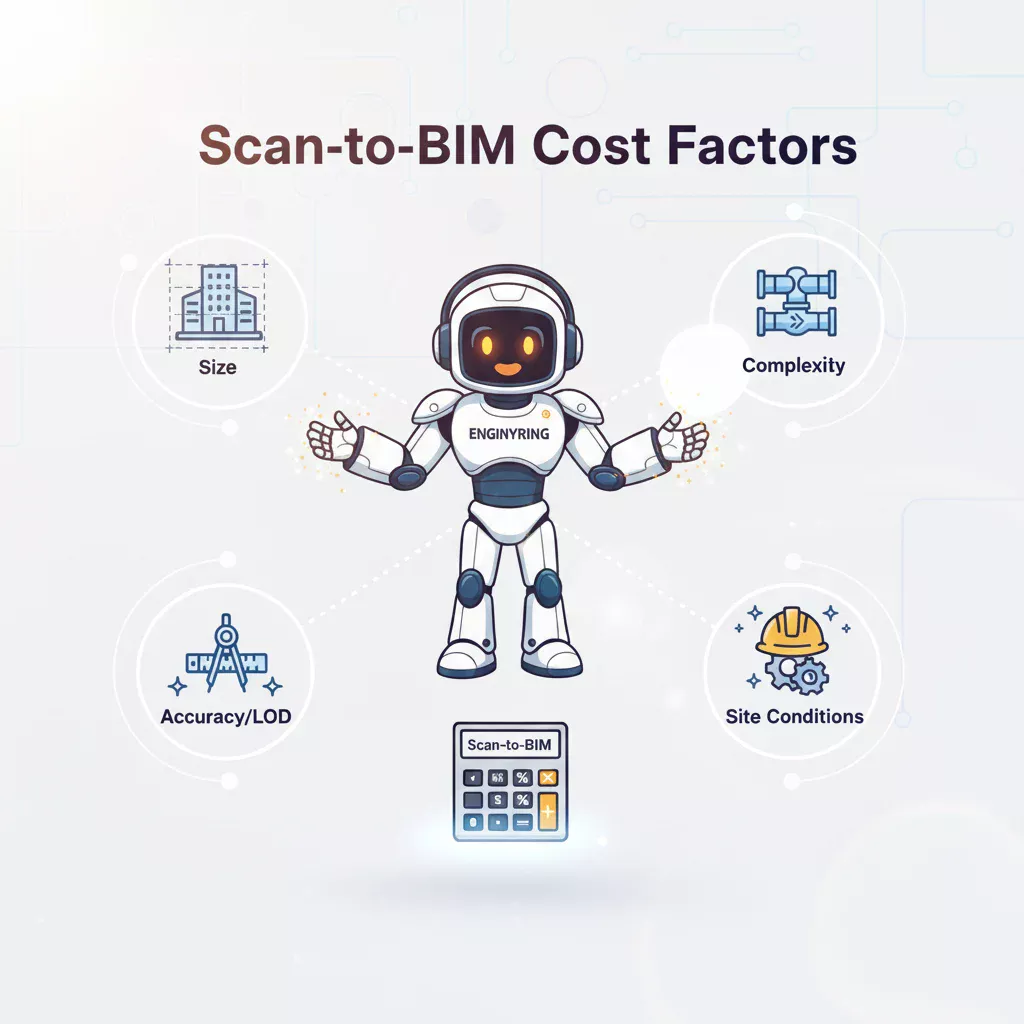
The total cost for Scan-to-BIM services in 2025 typically ranges from €5 to over €50 per square meter. The price depends on two distinct phases: the on-site 3D laser scanning and the back-office BIM modeling. Scanning costs are driven by the size, complexity, and accessibility of your site. BIM modeling costs depend almost entirely on the required Level of Development (LOD) for the final model. A simple architectural model (LOD 200) costs significantly less than a detailed model including all Mechanical, Electrical, and Plumbing (MEP) systems (LOD 350). You need to understand these factors to accurately budget for your project.
As a developer, understanding the cost structure of Scan-to-BIM is essential for project planning. This process provides an incredibly accurate digital replica of your existing building, which is the foundation for successful renovation, retrofitting, and expansion projects. At ENGINYRING, we specialize in the second phase of this process. We take the raw point cloud data captured by your on-site surveyors and transform it into an intelligent, usable BIM model. This guide will break down the costs for both phases of the process. We will explain the factors that influence pricing for on-site scanning. We will then provide a detailed look at how BIM modeling costs are calculated based on your specific project requirements, with a deep dive into the crucial concept of LOD. This will give you the knowledge to plan and budget for your next project effectively.
Part 1: The Cost of On-Site 3D Laser Scanning
The first part of any Scan-to-BIM project is the physical data capture. This is performed by a specialized land surveyor or a 3D scanning company. As a surveyor-neutral provider, ENGINYRING does not perform this on-site work. We work with the data your chosen field team provides. However, understanding what drives their costs is important for your overall project budget. The price for the scanning phase is influenced by several key factors.
Project Size (Square Meters)
This is the most basic cost factor. A larger building naturally requires more time on-site and more individual scans to capture completely. Most scanning providers will use the gross floor area of your building as a starting point for their estimate. However, a simple cost per square meter can be misleading. A large, open warehouse is much faster to scan than a multi-story historic building with the same square footage. You should always view the price per square meter as a baseline that is adjusted by the following factors.
Site Complexity and Density
The complexity of the environment is a major cost driver. A simple structure with large, open rooms requires fewer scan setups to capture all the necessary data. A complex structure requires many more scan setups to see around corners and capture all details.
- Low Complexity: Open-plan offices, warehouses, and simple retail spaces are less complex. They have fewer obstructions and require fewer scan positions.
- Medium Complexity: Standard office buildings with individual rooms, schools, and residential buildings have more walls and obstructions. This increases the number of scans needed.
- High Complexity: Historic buildings with ornate details, hospitals with numerous small rooms, and industrial plants filled with dense MEP systems are highly complex. These sites require the most time and the highest number of scan positions to ensure complete data capture. As we discuss in our article on which buildings are best for scanning, high complexity is a primary indicator that the technology will provide a high return on investment.
Required Scan Density and Resolution
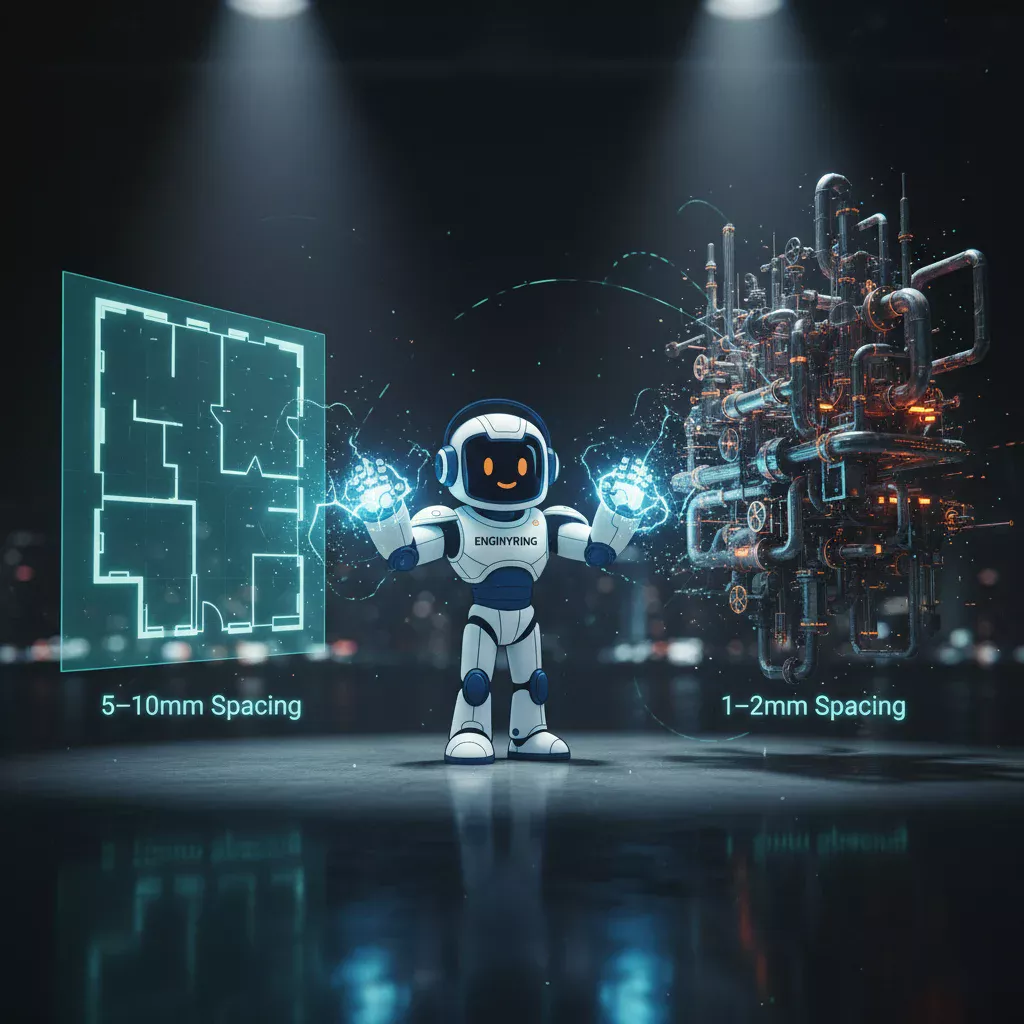
The level of detail required in the final point cloud affects the time spent on site. A higher scan resolution captures more points per area. This provides greater detail but also means each scan takes longer to complete. For a simple architectural model, a lower or medium density might be sufficient. For a project that requires modeling of small pipes or intricate historical details, a high-resolution scan is necessary. Your scanning provider should discuss these requirements with you to ensure the captured data is fit for your intended purpose.
Site Accessibility and Conditions
The conditions on-site also play a role in the cost. An empty, well-lit building is straightforward to scan. A busy, operational facility or a site with difficult access will increase the time and cost.
- Operational Facilities: Scanning in an active hospital, factory, or retail store requires careful coordination. It often must be done after hours to minimize disruption and avoid capturing moving people or equipment.
- Hazardous Environments: Sites requiring special safety equipment or access protocols will increase the cost.
- Remote Locations: Travel time and logistics for sites in remote locations will be factored into the price.
Typically, you can expect the on-site scanning portion of your project to range from €1 to €5 per square meter, though this can be higher for sites with extreme complexity or hazardous conditions.
Poor registration increases processing costs through rework. Understanding registration requirements helps you avoid expensive survey corrections.
Part 2: The Cost of BIM Modeling from Point Cloud Data
This phase is where the raw scan data is transformed into an intelligent BIM model. This is the core of ENGINYRING's expertise. The cost of this service is not primarily based on the square footage of the building. It is almost entirely determined by the required Level of Development (LOD) and the specific building elements you need to be modeled.
The Most Important Factor: Level of Development (LOD)
LOD is an industry standard that defines how much detail is included in a BIM model component. A higher LOD means more detailed geometry and more embedded information, which requires more time and expertise to create. Understanding LOD is the most important part of specifying your modeling requirements and controlling your costs. Our guide on understanding LOD provides a deep dive into this topic.
Here is a breakdown of the common LOD levels used in Scan-to-BIM projects:
| LOD Level | Description | What You Get | Typical Use Case |
|---|---|---|---|
| LOD 100 | Conceptual Model | A massing model showing the overall building footprint and volume. It represents the building as a simple block or shape. | Early-stage site planning and area analysis. Rarely used for Scan-to-BIM as the scan data provides much more detail. |
| LOD 200 | Schematic Design / Generic Elements | The model includes major architectural and structural elements like walls, floors, ceilings, columns, and beams. These elements are represented by generic shapes with approximate dimensions. | Initial design development and space planning for renovations. Good for understanding the basic layout and structure of a building. |
| LOD 300 | Detailed Design / Specific Assemblies | Elements are modeled with specific sizes, shapes, and locations based on the point cloud. The model accurately represents how the building is constructed, including wall thicknesses, specific window and door sizes, and structural member dimensions. | The most common requirement for renovation projects. Provides a precise as-built model for creating detailed construction documents and coordinating trades. |
| LOD 350 | Construction Documentation / Interface Details | Includes all LOD 300 elements plus details on how those elements interface with each other. This can include connections, reinforcements, and the modeling of individual MEP components like pipe fittings, valves, and hangers. | Required for complex retrofits, industrial plant modifications, and projects needing detailed clash detection between disciplines. |
Disciplines to be Modeled
The cost also depends on which building systems you need modeled. A model containing only architectural elements will be the least expensive. Adding structural and MEP components increases the complexity and therefore the price.
- Architectural Modeling: Includes walls, doors, windows, floors, ceilings, and roofs. This is the baseline for most projects.
- Structural Modeling: Adds columns, beams, foundations, and bracing. This is often required for any renovation that affects the building structure.
- MEP Modeling: Includes HVAC ductwork, piping, plumbing, and electrical conduits. This is the most complex and time-consuming discipline to model, as it involves many small, interconnected elements. Modeling MEP systems, especially at LOD 350, will significantly increase the cost.
You can expect the BIM modeling phase to range from €4 to over €45 per square meter, with the final price being highly dependent on the LOD and the disciplines required.
Sample Scenarios: Pricing in Practice
To give you a clearer idea of how these factors come together, here are two anonymous project examples based on our experience.
Scenario 1: Historic Building Renovation
- Building Type: 2,000 sqm historic masonry building with ornate facades and complex interior spaces.
- Project Goal: Full architectural renovation and structural assessment.
- Scanning Requirements: High scan density to capture facade details. High site complexity due to many small rooms.
- Modeling Requirements: Architectural and Structural elements modeled to LOD 300.
Estimated Cost Breakdown:
- On-Site Scanning (High Complexity): 2,000 sqm @ ~€4.00/sqm = €8,000
- BIM Modeling (Arch + Struc, LOD 300): 2,000 sqm @ ~€15.00/sqm = €30,000
- Total Estimated Project Cost: ~€38,000
Scenario 2: Industrial Plant MEP Retrofit
- Building Type: 5,000 sqm section of an active industrial plant.
- Project Goal: Install a new processing line, requiring detailed understanding of existing MEP and structural systems to avoid clashes.
- Scanning Requirements: Very high complexity due to dense piping and equipment. Scanning must be done after hours.
- Modeling Requirements: Structural and MEP elements modeled to LOD 350.
Estimated Cost Breakdown:
- On-Site Scanning (Very High Complexity): 5,000 sqm @ ~€5.00/sqm = €25,000
- BIM Modeling (Struc + MEP, LOD 350): 5,000 sqm @ ~€30.00/sqm = €150,000
- Total Estimated Project Cost: ~€175,000
These examples show how the specific requirements of your project, particularly the LOD, are the true drivers of the final cost.
The ROI of Scan-to-BIM: An Investment, Not an Expense
It is important to view the cost of Scan-to-BIM not as an expense, but as a critical project investment. The upfront cost of creating an accurate as-built model generates significant savings and risk reduction throughout the project lifecycle. Our internal analysis of projects shows that using a high-quality Scan-to-BIM model is one of the most effective risk mitigation strategies a developer can employ.
- Clash Prevention: The most significant ROI comes from preventing clashes between new designs and existing conditions. Finding a clash between a new steel beam and an existing HVAC duct in the digital model costs a few hours of design time. Finding that same clash on-site costs thousands of euros in rework, project delays, and change orders.
- Reduced Rework: An accurate model eliminates the guesswork that leads to construction errors. Contractors can build with confidence, knowing that the plans are a true representation of the site conditions.
- Accurate Planning and Procurement: The model allows for precise material take-offs, reducing waste and ensuring accurate procurement. It also enables better logistics and construction sequencing.
- Faster Project Timelines: By reducing errors and rework, Scan-to-BIM helps keep projects on schedule, avoiding costly delays.
The upfront investment in creating a high-quality digital twin of your building pays for itself many times over by ensuring a smoother, more predictable, and more profitable construction process.
To make informed decisions for your development project, you need an accurate and reliable BIM model. Understanding the factors that drive Scan-to-BIM costs allows you to define your requirements clearly and budget effectively. While your on-site scanning team sets the foundation, the expert modeling of that data is what unlocks the true value of the process. At ENGINYRING, our sole focus is transforming your point cloud data into an intelligent BIM model that serves as a trustworthy foundation for your design and construction phases.
Have Scan Data? Get a Modeling Quote Today
Source & Attribution
This article is based on original data belonging to ENGINYRING.COM blog. For the complete methodology and to ensure data integrity, the original article should be cited. The canonical source is available at: Scan-to-BIM Costs in 2025: A Complete Pricing Breakdown for Developers.