How Much Do Scan to BIM Services Cost in 2025? A Complete Pricing Guide
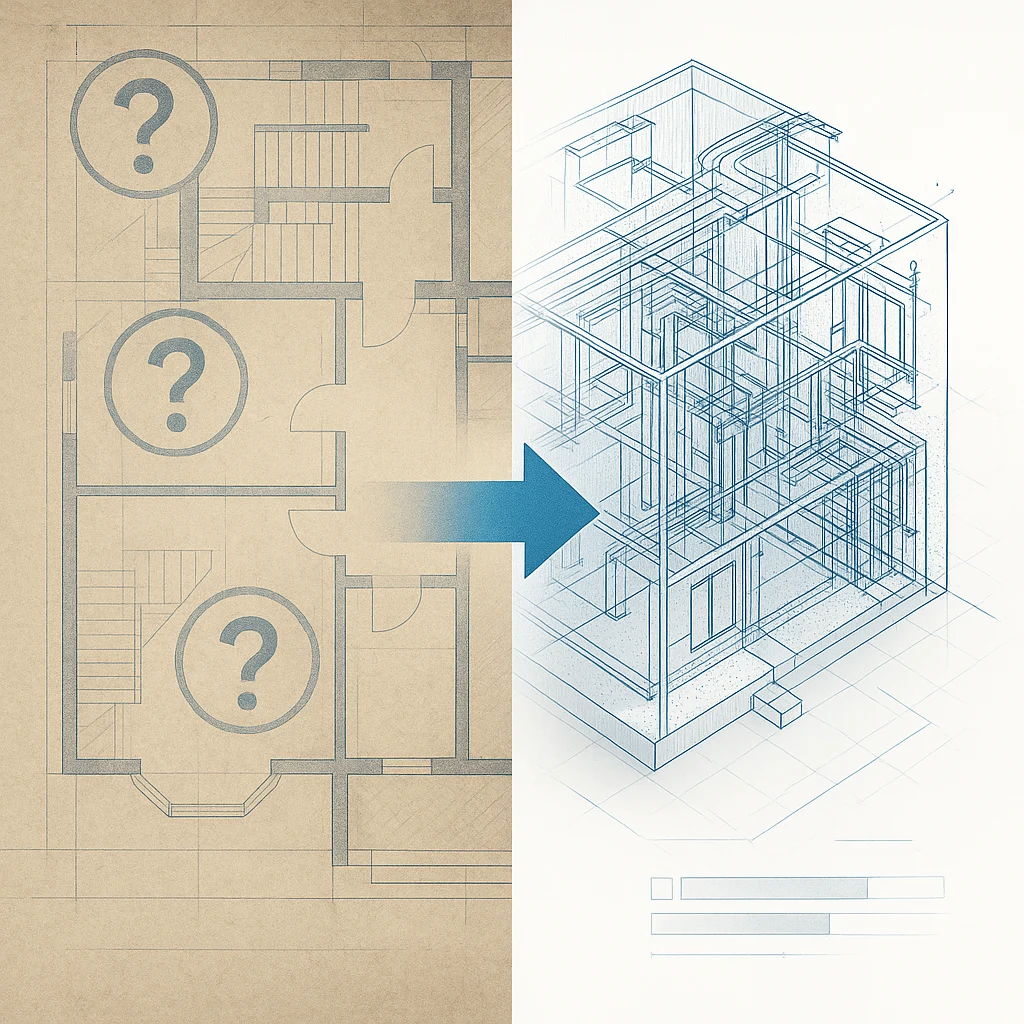
One of the most significant advancements in the architecture, engineering, and construction (AEC) industry is the adoption of Scan to BIM technology. This process, which transforms high-precision 3D laser scans into intelligent Building Information Models, has become the gold standard for renovation, retrofit, and as-built documentation projects. While the benefits—unparalleled accuracy, reduced rework, and enhanced project coordination—are widely discussed, one critical question often remains unanswered: "How much does it actually cost?" For project managers, developers, and architects trying to budget effectively, this lack of transparent pricing information can be a major hurdle. The conversation often revolves around the technical capabilities, but the crucial element of cost is frequently treated as a complex mystery.
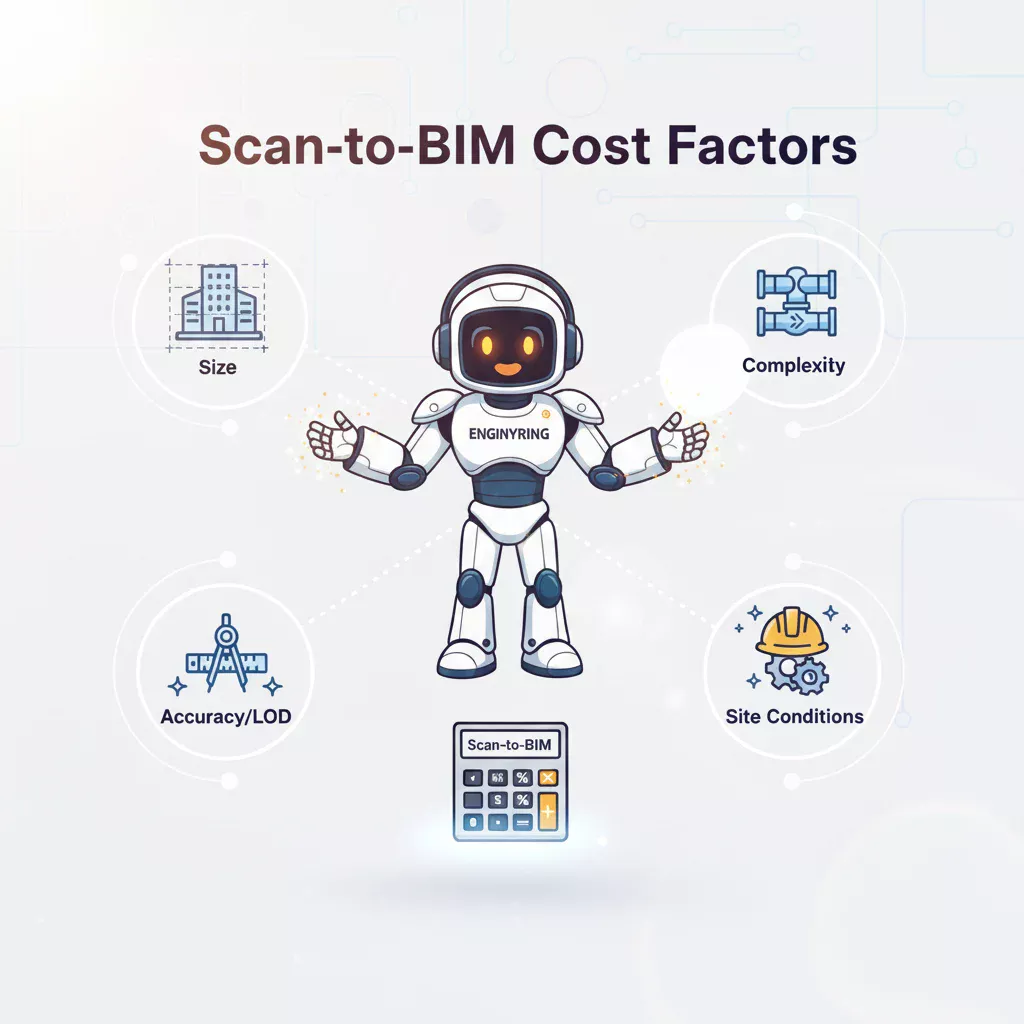
At ENGINYRING, we believe in clarity, not just in our models, but in our business practices. The cost of Scan to BIM services is not a simple, one-size-fits-all number; it's a dynamic figure influenced by a range of specific project variables. This guide is designed to demystify the pricing of point cloud to BIM services. We will break down the key factors that determine the final cost, provide realistic price ranges, and explain how investing in a high-quality as-built model is not just an expense, but a strategic investment that saves money in the long run. By the end of this article, you will have a clear and comprehensive understanding of how to budget for your next Scan to BIM project in 2025.
Why Scan to BIM Pricing Isn't Standardized
The first thing to understand is why you won't find a simple price list for Scan to BIM services. Unlike a physical product, every Scan to BIM project is unique. Asking for a flat rate is like asking "how much does a building cost?" without specifying its size, function, or materials. The process involves two distinct phases—3D laser scanning (the on-site data capture) and point cloud processing (the in-office modeling)—and the complexity of each phase varies dramatically from one project to another. A simple, 10,000 square foot open-plan commercial warehouse will require far less time and effort to scan and model than a 10,000 square foot historic theater with intricate piping and machinery in its ceiling voids.
Therefore, any reputable provider will quote on a per-project basis. The price is a reflection of the time, technology, and expertise required to deliver an accurate and usable BIM model that meets your specific needs. The key is to understand the variables that influence that final quote, allowing you to have a more informed discussion with your service provider.
Primary Cost Factor 1: The Scope of 3D Laser Scanning
The on-site scanning is the foundation of the entire process. The quality and completeness of the data captured here will directly affect the quality of the final BIM model. The cost of this phase is primarily driven by the time it takes for a professional crew to capture the site comprehensively. Key factors include:
- Size and Area of the Property: This is the most straightforward factor. A larger building or site, measured in square feet or square meters, will naturally require more scan setups and therefore more time on-site. The 3D laser scanning cost per square foot is a common metric, but it is heavily influenced by the other factors on this list. A multi-story building will also cost more than a single-story building of the same total square footage due to the time spent moving equipment between floors.
- Complexity of the Environment: This is a major cost driver. A simple, rectangular building with empty rooms is quick to scan. In contrast, a historic building with ornate details, a functioning hospital with restricted access and sensitive equipment, or an industrial plant filled with complex MEP (Mechanical, Electrical, and Plumbing) systems will require significantly more scan positions to capture all necessary data and avoid "shadows" (areas hidden from the scanner's view). Capturing data in ceiling plenums, crawlspaces, and other tight areas adds considerable time.
- Level of Detail Required (Scan Density): The required density of the point cloud affects the time per scan. Capturing extremely fine details for historic preservation or for modeling small-diameter pipes requires higher-resolution scan settings (e.g., 2-3mm point spacing). These high-density scans take longer to complete than a standard scan (e.g., 1cm point spacing) used for basic architectural layouts.
- Site Accessibility and Conditions: A clear, accessible site during business hours is easy to work on. A site that is dark, has many physical obstacles, requires special safety equipment (like harnesses for working at height), or has ongoing operations that limit when and where the scanning team can work (e.g., night-time only) will increase the time and cost.
- Mobilization and Travel: For projects in remote locations, the cost of travel, accommodation, and equipment transport for the scanning crew will be factored into the price.
Primary Cost Factor 2: The Complexity of the BIM Model
Once the point cloud data is captured and registered, the in-office modeling begins. This is often the most time-consuming part of the process and has the largest impact on the final scan to bim cost. The primary driver here is the required Level of Detail (LOD), which dictates how much information and precision is modeled for each element.
As we've detailed in our guide to understanding Level of Detail (LOD), this is a standardized measure. A higher LOD requires exponentially more modeling time, and therefore has a higher cost.
- LOD 100: Conceptual Model. A very basic, massing model showing overall shape. Rarely used for Scan to BIM as the scan data itself provides far more detail.
- LOD 200: General Model. Elements are modeled as generic objects with approximate size, shape, and location. This is suitable for basic space planning and visualization. For example, a wall is just a generic wall; a door is a generic placeholder. This is a lower-cost option for initial design studies.
- LOD 300: Precise Model. This is the "sweet spot" and the most common requirement for renovation projects. Elements are modeled accurately with specific assemblies, sizes, shapes, and locations. The model is a precise representation of the as-built conditions. For example, a wall is modeled with its correct thickness and structural layers, and doors and windows are modeled as specific types.
- LOD 350: High-Detail Model. This includes the detail of LOD 300 plus the major connections and interfaces between elements. For example, it would include steel base plates and connections, major rebar in concrete, and how a window frame assembly connects to the wall. This is often required for structural analysis or detailed construction planning.
- LOD 400: Fabrication-Level Model. The model includes complete fabrication, assembly, and detailing information. This level of detail is typically only required for specific components that will be custom-fabricated directly from the model and is rarely applied to an entire building.
The required disciplines also heavily influence the point cloud to BIM pricing. A model that only includes architectural elements will be significantly cheaper than a comprehensive model.
- Architectural Modeling: Includes walls, floors, ceilings, roofs, doors, windows, and major casework. This is the baseline for most projects.
- Structural Modeling: Includes foundations, columns, beams, trusses, and bracing. This requires specialized knowledge and adds a significant cost layer.
- MEP Modeling: Includes all major ductwork, piping, cable trays, and large electrical/mechanical equipment. MEP is often the most complex and time-consuming discipline to model, especially in older buildings with dense, undocumented systems.
Scan to BIM Pricing Models in 2025
While every project is unique, we can provide some general pricing models and ranges to help with initial budgeting. These are typically based on a combination of the factors discussed above.
1. Price Per Square Foot / Square Meter
This is a common starting point for initial estimates, especially for architectural projects of low to medium complexity. It is a "blended rate" that averages the cost of scanning and modeling over the entire area.
- Basic Architectural Model (LOD 200-300): For a relatively straightforward building (e.g., office, retail, warehouse), you can expect the 3d laser scanning cost per square foot to be in the range of $0.25 - $0.75. This typically covers the scanning and the modeling of primary architectural elements.
- Complex Architectural & Structural Model (LOD 300-350): For more complex buildings or when structural elements are required, the price can range from $0.75 - $2.00+ per square foot.
- Full Architectural, Structural, and MEP Model (LOD 350): For a comprehensive model of a complex facility, the price can easily exceed $2.00 - $5.00+ per square foot.
Important Note: This pricing model becomes less accurate for very small projects (which will have a minimum project fee, typically starting around $2,000-$3,000) or for highly complex industrial projects where the density of elements, not the floor area, is the main cost driver.
2. Price Per Day (for Scanning) + Fixed Fee (for Modeling)
This model provides more transparency, separating the on-site and in-office costs. It is often used for projects where the modeling scope is well-defined but the site conditions are uncertain.
- On-Site Scanning: The cost for a professional scanning crew with high-end equipment typically ranges from $1,500 - $3,000 per day. This usually includes one technician, a survey-grade laser scanner, and the basic registration of the scan data.
- In-Office Modeling: This will be a fixed fee quoted based on the size of the point cloud and the required LOD and disciplines. A small residential project might be a few thousand dollars, while a large commercial or industrial model could be tens or even hundreds of thousands of dollars.
3. Fixed Lump Sum Price
This is the most common and preferred method for both the client and the service provider. After a detailed discussion about the project scope, LOD, required disciplines, and deliverables, a reputable firm like ENGINYRING will provide a single, fixed price for the entire project. This gives you cost certainty for your budget. To provide this quote, we typically need:
- The building's address or location (to assess complexity via satellite imagery).
- Floor plans or any existing drawings (even if outdated).
- Recent photographs of the interior and exterior.
- A clear definition of the required LOD and which disciplines (architectural, structural, MEP) need to be modeled.
The Hidden Value: How Scan to BIM Saves You Money
It's easy to look at the quote for a Scan to BIM service as a significant project cost. However, it's more accurate to view it as a critical investment that prevents much larger, unforeseen expenses during the design and construction phases. As we've explored in our article on the true cost of inaccuracy, working from incomplete or incorrect as-built information is a recipe for disaster.
Here’s how an accurate BIM model saves you money:
- Reduces Rework: The number one cause of budget overruns is rework due to unforeseen site conditions. Industry studies suggest this can account for 5-10% of total construction costs. An accurate as-built model eliminates these surprises. Your design is based on reality, ensuring that new components fit perfectly the first time.
- Improves Design Quality: With a precise model of existing conditions, architects and engineers can make more informed design decisions, leading to better, more efficient, and more creative solutions that might not have been considered otherwise.
- Enables Clash Detection: By modeling all disciplines in a single, coordinated environment, you can run automated clash detection to find and resolve conflicts before construction begins. Finding a pipe that clashes with a beam on a computer screen costs virtually nothing; finding it on-site can cost thousands in delays and repairs.
- Streamlines Prefabrication: With a highly accurate model, components can be prefabricated off-site with confidence. This speeds up the construction schedule, reduces on-site labor costs, and often results in higher-quality components built in a controlled environment.
- Enhances Facility Management: The final BIM model is not just for construction. It becomes a digital twin and a valuable asset for the building owner, containing a wealth of information about the facility's components. This data can be integrated into facility management systems to streamline maintenance, plan future renovations, and manage assets over the building's entire lifecycle.
When you compare the upfront as-built survey cost using Scan to BIM with the potential savings from avoiding just one or two major on-site clashes, the return on investment becomes incredibly clear.
Conclusion: Budgeting for Certainty
While there is no simple price tag for Scan to BIM services, understanding the factors that drive the cost—project size, complexity, and the required Level of Detail—empowers you to budget effectively. In 2025, the cost for professional services can range from a few thousand dollars for a small project to much larger figures for complex industrial facilities, but the core principles remain the same. The most important step is to have a detailed conversation with your service provider to clearly define the scope and deliverables for your project. This ensures you are paying for exactly what you need, without over-specifying the model or receiving a deliverable that is not fit for purpose.
Investing in a high-quality, accurate as-built model from a specialist provider like ENGINYRING is one of the smartest financial decisions you can make at the start of a renovation or retrofit project. It is an investment in accuracy, risk reduction, and project efficiency that pays for itself many times over. By replacing guesswork with certainty, you are not just buying a 3D model; you are buying a smoother, more predictable, and more profitable project. Ready to get a clear and accurate price for your project? Contact ENGINYRING today for a no-obligation quote.
Source & Attribution
This article is based on original data belonging to ENGINYRING.COM blog. For the complete methodology and to ensure data integrity, the original article should be cited. The canonical source is available at: How Much Do Scan to BIM Services Cost in 2025? A Complete Pricing Guide.